
10 Professional Ways to Say "Per My Last Email" (With Examples)
We've all been there. You send an email explaining something important, wait for a response, and receive a reply that suggests the message was never read. Your first instinct might be to write, "Per my last email..."
Although the phrase is common in professional communication, it can sound impatient, defensive, or passive-aggressive, especially when the recipient is already under pressure.
The good news? You can follow up, repeat information, and request an answer without creating unnecessary tension. Choosing the right per my last email alternative helps you stay professional while making your message clear.
In this guide, you'll find 10 polite alternatives, practical email examples, and tips for following up without sounding annoyed.
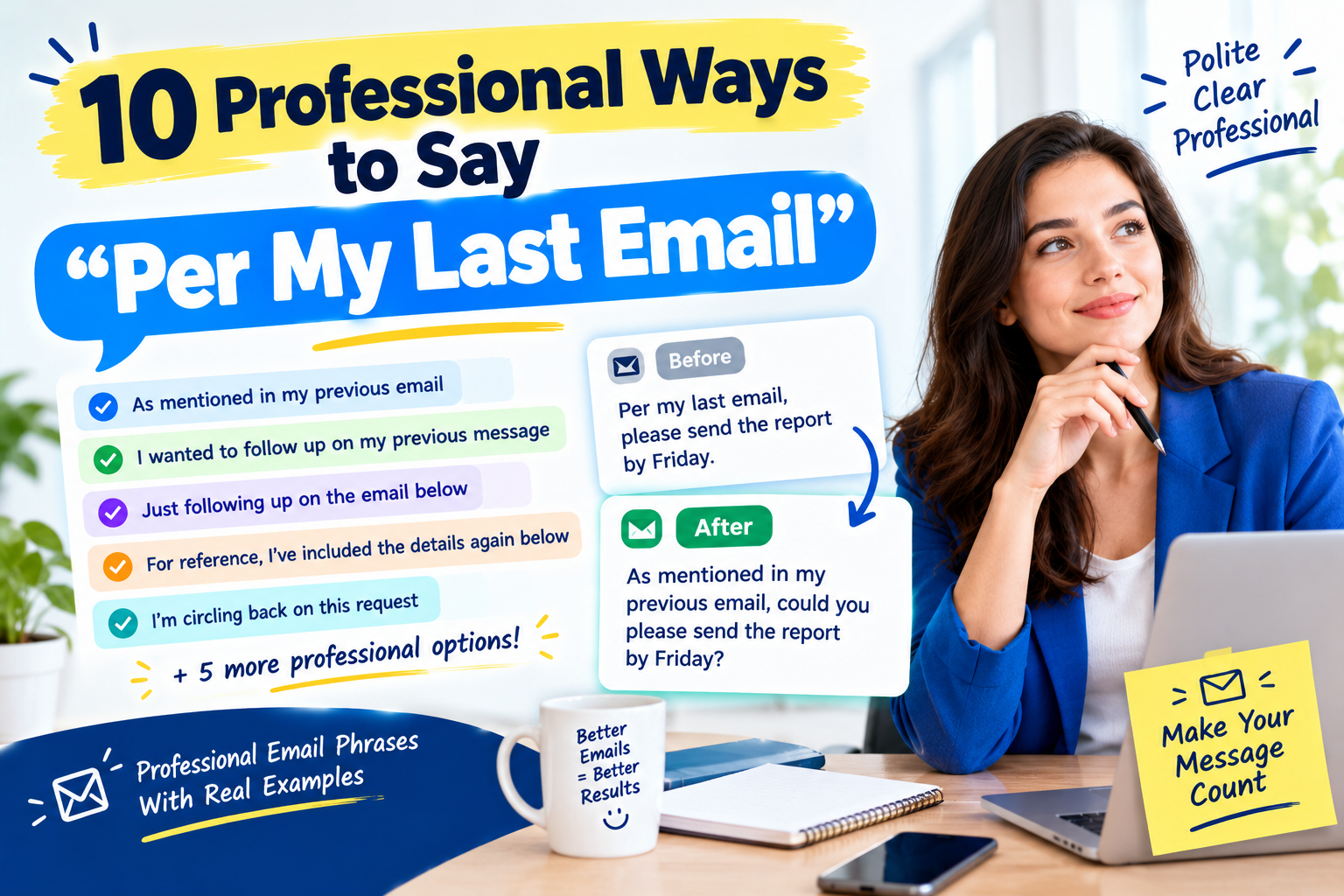
Why Can "Per My Last Email" Sound Rude?
The phrase itself isn't inherently rude. It's a formal way to refer to something you previously communicated. However, context and tone can change how a reader interprets it.
For example:
Original: "Per my last email, I need the report by Friday."
Depending on the relationship and situation, the recipient might interpret this as, "I already told you this, so why haven't you done it?"
That interpretation becomes more likely when the phrase is followed by a complaint, a missed deadline, or an obvious reminder.
Instead of emphasizing that you already sent the information, focus on what the recipient needs to know or do next.
10 Professional Alternatives to "Per My Last Email"
Here are 10 professional email phrases you can use in different situations, from a friendly reminder to a firm follow-up.
1. "As mentioned in my previous email"
Best for: Referring to information you've already shared.
This is one of the most direct and professional alternatives. It reminds the reader of the earlier message without drawing attention to their failure to respond.
Before:
"Per my last email, the revised proposal is attached."
After:
"As mentioned in my previous email, I've attached the revised proposal for your review."
Why it works: It keeps the focus on the document and the next step rather than on the fact that you sent an earlier email.
2. "I wanted to follow up on my previous message"
Best for: Following up when someone hasn't replied.
This phrase is particularly useful when you need an update but don't want to sound impatient.
Before:
"Per my last email, have you approved the budget?"
After:
"I wanted to follow up on my previous message to see whether you've had a chance to review the budget."
Why it works: It gives the recipient room to respond without making assumptions about why they haven't replied.
3. "Just following up on the email below"
Best for: Short, routine reminders.
This alternative works well in ongoing conversations where the original message is visible in the email thread.
Before:
"Per my last email, please send the signed agreement."
After:
"Just following up on the email below. Could you please send the signed agreement when you have a chance?"
Why it works: It is concise, approachable, and clear about the action you need.
Tip: If the request is urgent, replace "when you have a chance" with a specific deadline.
4. "For reference, I've included the details again below"
Best for: Repeating information or making an earlier message easier to find.
Sometimes a recipient genuinely missed the original message. Resending the relevant details can be more helpful than asking them to search through a long email thread.
Before:
"Per my last email, the meeting is at 10 AM."
After:
"For reference, I've included the meeting details again below: Tuesday at 10 AM in Conference Room B."
Why it works: It makes the information immediately accessible and saves the recipient time.
5. "I’m circling back on this request"
Best for: Business communication and project follow-ups.
"Circling back" is a familiar expression in professional environments. It works when you need to revisit a topic that hasn't been resolved.
Before:
"Per my last email, we still need your feedback."
After:
"I'm circling back on this request to see whether you have any feedback on the draft."
Why it works: It signals that the topic remains open without directly blaming the recipient.
Tip: Use it when it sounds natural for your workplace. In a very formal message, "I'm following up on this request" may be clearer.
6. "Could you please confirm that you received my previous email?"
Best for: Important messages that may not have reached the recipient.
If the issue is whether someone saw the original message, ask directly instead of implying that they ignored it.
Before:
"Per my last email, I need confirmation today."
After:
"Could you please confirm that you received my previous email regarding today's deadline?"
Why it works: It checks receipt without assuming the person deliberately overlooked the message.
7. "I’m resending the information for convenience"
Best for: Sharing attachments, links, or instructions again.
This phrase is helpful when the recipient needs the original material to move forward.
Before:
"Per my last email, here's the file again."
After:
"I'm resending the file for convenience. Please let me know if you're unable to access the attachment."
Why it works: It offers a practical solution and leaves room for technical issues or a missing attachment.
8. "When you have a moment, could you share an update?"
Best for: Polite follow-ups when the deadline isn't immediate.
This is a good choice when you need progress information but don't want to pressure someone unnecessarily.
Before:
"Per my last email, what's the status?"
After:
"When you have a moment, could you share an update on the project timeline?"
Why it works: It makes the request sound collaborative while identifying exactly what you need.
Tip: Avoid this wording when the matter is genuinely urgent. In that case, state the required response time clearly.
9. "To keep things moving, could you please..."
Best for: Time-sensitive tasks and project coordination.
Sometimes a soft reminder isn't enough. This phrase helps communicate urgency while keeping the message focused on progress.
Before:
"Per my last email, approve the designs today."
After:
"To keep things moving, could you please approve the designs by 3 PM today?"
Why it works: It explains the practical reason for the request and gives the recipient a clear deadline.
10. "I’d appreciate your response by [date]"
Best for: Firm follow-ups when you need a decision or answer.
If you've already sent multiple reminders, another vague follow-up may not help. A clear deadline is often more effective.
Before:
"Per my last email, I need your response ASAP."
After:
"I'd appreciate your response by Thursday, October 22, so we can finalize the next steps on schedule."
Why it works: It establishes a concrete expectation without using accusatory language.
Tip: Choose a realistic deadline and explain the consequence of a delay when relevant.
Quick Comparison: Which Alternative Should You Use?
Use this table to choose the right professional email phrase for your situation.
| Situation | Professional alternative | Tone |
|---|---|---|
| Repeating information | "As mentioned in my previous email..." | Neutral |
| No response received | "I wanted to follow up on my previous message." | Polite |
| Short reminder | "Just following up on the email below." | Friendly |
| Sharing details again | "For reference, I've included the details again below." | Helpful |
| Revisiting an open issue | "I'm circling back on this request." | Businesslike |
| Checking receipt | "Could you please confirm that you received my previous email?" | Direct |
| Resending an attachment | "I'm resending the information for convenience." | Helpful |
| Requesting progress | "When you have a moment, could you share an update?" | Considerate |
| Moving a task forward | "To keep things moving, could you please..." | Action-oriented |
| Requiring a decision | "I'd appreciate your response by [date]." | Firm |
Before-and-After Examples: Make Your Email Sound Professional
Sometimes, the problem isn't one particular phrase. It's the overall wording of the email. Here are three common situations and ways to rewrite them.
Example 1: When a colleague hasn't replied
Before — sounds frustrated:
"Per my last email, I asked you to send the figures. I still haven't received them."
After — professional and clear:
"Hi Alex,
I'm following up on the figures requested in my previous email. Could you please send them by the end of the day so I can complete the report?
Thanks for your help."
Why the rewrite works: It removes the implied criticism, states the request, and explains the deadline.
Example 2: When a client hasn't approved a proposal
Before — sounds impatient:
"As I already said in my last email, we can't proceed without your approval."
After — professional and constructive:
"Hi Jordan,
I wanted to check whether you've had a chance to review the proposal. We'll be able to move to the next stage once we receive your approval.
Please let me know if you have any questions or would like any changes.
Best regards,"
Why the rewrite works: It communicates the dependency without making the client feel blamed.
Example 3: When someone repeatedly misses a deadline
Before — sounds confrontational:
"Per my last three emails, this was supposed to be completed yesterday."
After — firm but respectful:
"Hi Sam,
I'm following up because the agreed deadline has passed, and we still need the completed file. Please send it by 2 PM tomorrow or let me know immediately if there's a blocker.
This will help us adjust the project timeline if necessary.
Thank you."
Why the rewrite works: It documents the missed deadline, establishes a new expectation, and asks for early notice of any obstacles.
How to Follow Up Politely Without Sounding Annoyed
Choosing the right phrase helps, but the structure of your message matters too. Use these five principles to make your follow-up more effective.
1. Start with the purpose
Explain why you're writing instead of highlighting how many times you've already contacted the person.
Instead of: "I've emailed you about this several times."
Try: "I'm following up to confirm the delivery date."
2. Refer to the earlier message neutrally
A simple reference is usually enough.
For example:
"Following up on my email from Monday about the revised contract..."
This provides context without criticizing the recipient.
3. Make one clear request
Avoid lengthy paragraphs that mix frustration, background information, and several unrelated questions.
Try:
"Could you please confirm the final quantity by noon tomorrow?"
A specific request is easier to understand and answer.
4. Give a reasonable deadline when necessary
If the task is time-sensitive, say when you need a response and why.
For example:
"Could you share your feedback by Wednesday? We need to finalize the presentation before Thursday's client meeting."
A clear reason helps the recipient understand the priority.
5. Keep frustration out of the written message
Phrases such as "as I already explained," "as previously stated," and "as I've told you before" can sound irritated in some contexts.
They aren't always inappropriate, but repeated use may make the message seem accusatory.
When emotions are running high, draft the email, pause, and review it before sending. You can also use an AI Professional Tone Converter to rewrite an emotional draft in a more neutral, professional style.
How to Rewrite an Angry Email Professionally
If you're annoyed, you don't have to pretend that a problem doesn't exist. The goal is to communicate the problem clearly without adding unnecessary hostility.
A useful approach is to replace blame with facts, state the impact, and explain the next action.
Step 1: Identify the actual problem.
Instead of writing, "You keep ignoring my emails," identify what is missing: "I haven't yet received the requested approval."
Step 2: Remove emotionally charged wording.
Replace phrases such as "I already told you," "obviously," and "for the last time" with neutral descriptions of the situation.
Step 3: Explain the impact.
For example: "Without approval, we can't submit the final design to the client."
Step 4: State the action you need.
For example: "Could you please approve the design by 11 AM tomorrow?"
Step 5: Review the tone before sending.
Check whether the message sounds respectful, whether the request is clear, and whether the deadline is realistic.
A simple rewrite formula
Use this structure for difficult professional emails:
Context + Current status + Required action + Deadline
Example:
"I'm following up on the invoice sent on October 12. Payment hasn't yet appeared in our records. Could you confirm the payment status by Friday? Please let me know if you need another copy of the invoice."
This formula works for project updates, client approvals, overdue documents, payment reminders, and unanswered requests.
Common Email Phrases That Can Sound Passive-Aggressive
"Per my last email" isn't the only phrase that can be interpreted negatively. These expressions may also sound impatient depending on context.
| Phrase | Why it may sound negative | Better alternative |
|---|---|---|
| "As I already explained..." | Suggests the recipient wasn't paying attention | "To clarify..." |
| "As previously stated..." | Can sound defensive or corrective | "As discussed earlier..." |
| "As I mentioned before..." | May imply frustration when repeated | "For reference..." |
| "Just a reminder..." | Can sound pointed if the deadline has passed | "A quick reminder that the deadline is..." |
| "Please advise." | Can sound abrupt without context | "Could you let me know your recommendation?" |
| "Per my instructions..." | May sound hierarchical or accusatory | "Following the process we discussed..." |
| "As you should know..." | Implies the recipient is at fault | State the relevant information directly |
These expressions aren't automatically rude. In formal documentation or established workplace conventions, some may be appropriate. Consider your relationship with the recipient, the urgency of the situation, and the rest of the message.
When Is It Appropriate to Be More Direct?
Professional communication doesn't always mean being indirect or overly friendly. If a deadline has passed, a compliance issue exists, or a decision is blocking other work, you may need a firmer message.
A direct email should still be factual and respectful.
For example:
"Following up on the outstanding approval. We need confirmation by 4 PM on Friday to meet the submission deadline. If approval isn't possible by then, please let me know so we can discuss an alternative timeline."
This wording makes the urgency clear without attacking the recipient.
If you've already followed up several times, keep a record of previous requests and agreed deadlines. For serious workplace issues, use the appropriate escalation process rather than relying on increasingly frustrated emails.
Make Your Email Sound More Professional with TrendPro
Not sure whether your draft sounds polite, too blunt, or passive-aggressive? You don't have to rewrite it from scratch.
Use the AI Professional Tone Converter to improve the tone of your message while preserving its meaning.
Here's a simple workflow:
- Paste your original email into the tool.
- Convert the wording to a professional, polite tone.
- Review the revised message for accuracy and context.
- Add any missing details, deadlines, or specific requests.
- Copy the final version into your email.
Paste your draft and we'll make it professional.
The goal isn't to make every email sound overly formal. It's to help you communicate clearly, respectfully, and confidently.
Before pasting confidential business information, remove sensitive details such as passwords, private customer data, or information your organization doesn't permit you to share with external tools.
Frequently Asked Questions
Is "per my last email" rude?
Not necessarily. "Per my last email" is a formal phrase used to refer to a previous message. However, it can sound passive-aggressive when the context suggests frustration, especially if the recipient has already missed a request or deadline.
For a more neutral tone, try "I'm following up on my previous email" or "As mentioned in my previous message."
How do I remind someone politely without sounding annoyed?
Start with a neutral statement, briefly mention the earlier message, and make a clear request. For example:
"Hi Taylor, I'm following up on my email about the updated schedule. Could you please share your feedback by Thursday? Thanks for your help."
Avoid blaming the recipient or emphasizing how many times you've already contacted them unless that information is necessary.
How do I rewrite an angry email professionally?
Remove personal criticism and emotional language, describe the facts, explain the impact, and state the action you need.
For example, change "I've asked you three times and you still haven't sent it" to "I'm following up on the outstanding document. Could you please send it by 3 PM tomorrow or let me know if there's a delay?"
You can also use the AI Professional Tone Converter to help make your wording more professional.
What is the most polite alternative to "per my last email"?
"I'm following up on my previous email" is a safe, versatile choice for most workplace situations. If you are simply repeating information, "For reference, I've included the details below" may be even more helpful.
How long should I wait before sending a follow-up email?
For routine work requests, waiting one or two business days is often reasonable. For urgent or deadline-sensitive matters, follow up sooner if necessary and make the required response time clear. The right interval depends on the urgency, workplace expectations, and the recipient's role.
Final Thoughts
The best alternative to "per my last email" depends on what you need to accomplish. If you want to remind someone, use a friendly follow-up. If you need to repeat information, make it easy to find. If a deadline has passed, be direct about the next action and when you need it.
The key is to focus on the issue rather than the recipient's failure to respond.
Try the AI Professional Tone Converter to turn a frustrated draft into a clear, professional message.
Paste your draft and we'll make it professional.