
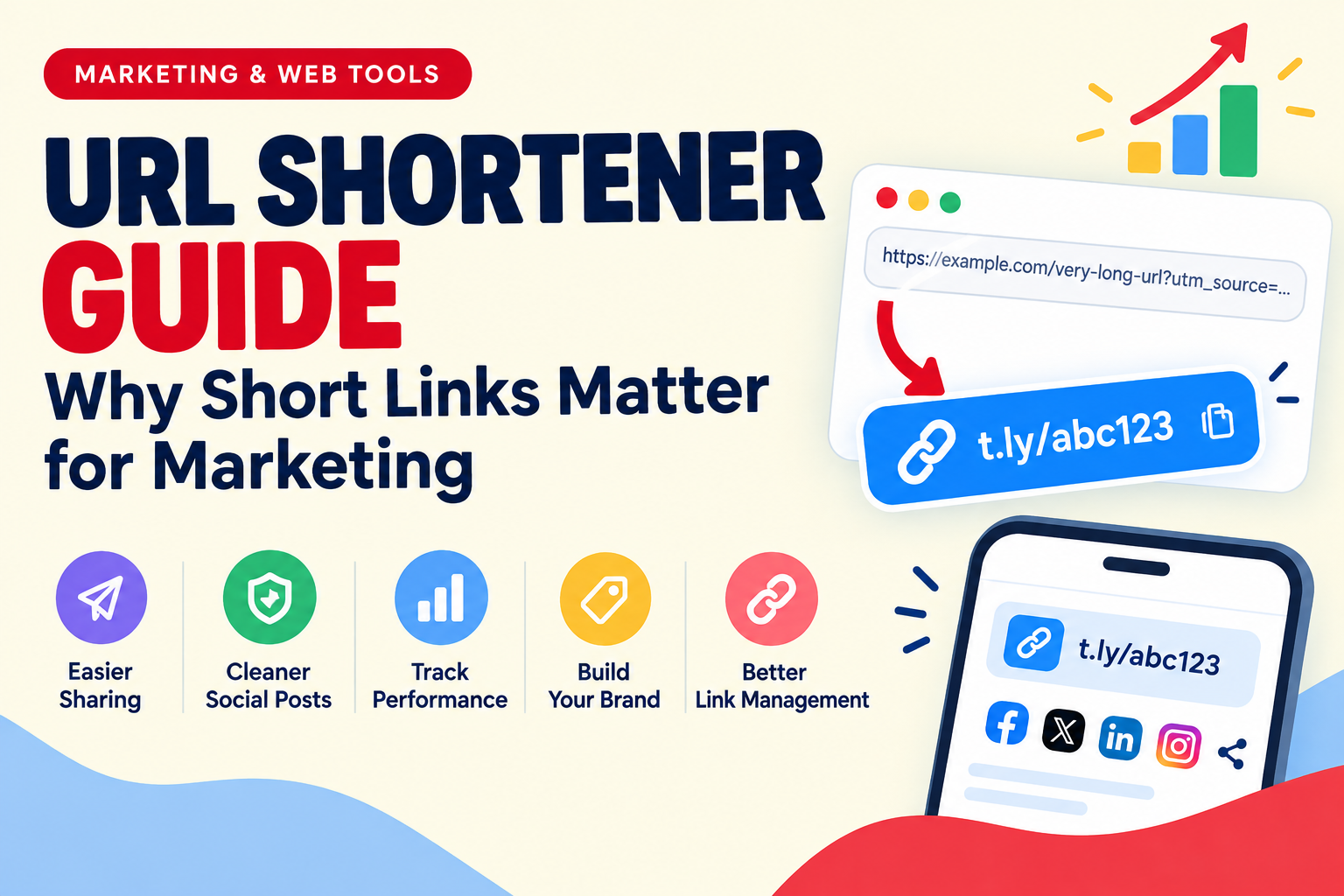
Long URLs can be difficult to share, remember, and manage. A URL containing tracking parameters, campaign information, product IDs, or multiple query strings can quickly become difficult to read.
A URL shortener solves this problem by converting a long web address into a shorter, easier-to-share link.
For marketers, creators, businesses, and everyday internet users, short links can make link sharing cleaner while also providing useful options for tracking and URL management.
In this guide, we'll explain how URL shortening works, why short URLs are useful, how marketers use them, and what you should consider when choosing an online URL shortener.
What Is a URL Shortener?
A URL shortener is a tool or service that converts a long URL into a much shorter web address.
For example, a long URL could look like:
https://example.com/products/category/product-name?utm_source=facebook&utm_medium=social&utm_campaign=summer-sale
A shortened version could look like:
https://short.example/a8K92x
When someone opens the short URL, the shortening service redirects the visitor to the original destination.
This simple process makes short links easier to share across websites, social media, messaging applications, emails, printed materials, and other marketing channels.
How Does URL Shortening Work?
The basic process behind url shortening is relatively simple.
Step 1: Enter the Original URL
The user provides the complete destination URL to a link shortener.
Step 2: Generate a Unique Short Code
The shortening service creates a unique identifier for that URL.
For example:
https://example.com/very-long-page-url

↓

https://short.example/Ab72x
The short code identifies the destination stored by the shortening system.
Step 3: Store the Destination
The service associates the short code with the original URL.
Conceptually, the system stores something similar to:
Ab72x → https://example.com/very-long-page-url
Step 4: Redirect the Visitor
When someone visits the short URL, the service looks up the associated destination and redirects the visitor.
The entire process usually happens very quickly.
Why Are Short URLs Useful?
There are several reasons people use a short URL instead of sharing the original address.
1. Easier Link Sharing
Short links are easier to copy, paste, type, and share.
This is particularly useful when a URL contains many parameters or a long page path.
2. Cleaner Social Media Posts
Long URLs can make social media posts look cluttered.
A short link takes up less visual space and can make promotional content easier to read.
3. Better for Printed Materials
Short links are useful for posters, flyers, business cards, presentations, and other physical marketing materials.
A shorter URL is generally easier for someone to type manually.
4. Easier to Remember
A carefully designed short URL can be easier to remember than a long URL containing multiple parameters.
5. Campaign Tracking
Many professional URL shortening platforms provide analytics.
Depending on the service, marketers may be able to see information such as:
- Number of clicks
- Click dates and times
- Referring sources
- Geographic information
- Device types
- Browser information
- Campaign performance
These features can make short links valuable marketing tools.
URL Shorteners for Digital Marketing
URL shorteners have become useful digital marketing tools because marketers often need to distribute the same destination through multiple channels.
For example, a company might promote the same landing page through:
- Email newsletters
- YouTube
- Blog posts
- QR codes
- Printed advertisements
Using separate short links for different campaigns can make it easier to understand which channels generate traffic.
For example:
Campaign A:
https://short.example/summer

Campaign B:
https://short.example/email

Campaign C:
https://short.example/social
If the shortening platform provides analytics, marketers can compare the performance of these links.
Short Links and Branding
Some URL shortening services support branded short domains.
Instead of using a generic domain, a company can potentially create links such as:
brand.example/sale
rather than:
short.example/X8k92P
Branded links can make campaigns look more professional and can help users recognize the organization behind the link.
For businesses that regularly publish promotional content, branded short links can become part of their overall marketing identity.
URL Shortening vs. URL Encoding
URL shortening and URL encoding are different processes.
URL shortening creates a smaller URL that redirects to another URL.
URL encoding converts special characters into a format that can safely be transmitted within a URL.
For example, spaces and certain special characters may be represented using percent-encoded values.
If you need to encode URL components rather than create a short redirect link, the URL Encoder can be useful.
Understanding this distinction is important because these two url tools solve different problems.
URL Shorteners and QR Codes
Short URLs can also work well with QR codes.
A QR code stores information that can be scanned by a smartphone. When the encoded destination is a shorter URL, the QR code can sometimes contain less data than it would for a very long URL.
This can be useful for:
- Posters
- Product packaging
- Restaurant menus
- Business cards
- Event tickets
- Marketing campaigns
- Printed advertisements
You can create scannable codes using the QR Code Generator.
A common marketing workflow looks like:
Landing Page
     ↓
Short URL
     ↓
QR Code
     ↓
User scans
     ↓
Landing Page
Are URL Shorteners Good for SEO?
A common question is whether URL shorteners directly improve search engine rankings.
The short answer is no.
Creating a shorter URL does not automatically improve a webpage's search ranking.
Search engines evaluate many factors when determining rankings, including content quality, relevance, technical accessibility, links, page experience, and other signals.
A short link can still be useful for marketing, distribution, and analytics, but it should not be treated as an SEO ranking shortcut.
For SEO purposes, the actual destination URL and webpage remain important.
Do Short Links Hide the Original URL?
Yes.
One characteristic of a shortened URL is that the visible link does not necessarily reveal the final destination.
For example:
https://short.example/X72kQ
could redirect to:
https://example.com/products/special-offer/summer-sale
This can be convenient, but it also means users may not know where a link will lead before clicking it.
For this reason, users should be cautious with unfamiliar shortened links.
Security Considerations When Using Short Links
URL shorteners can be useful, but they also introduce some security considerations.
Because the final destination is hidden behind a redirect, malicious actors can potentially use shortened links to make suspicious destinations less obvious.
Before clicking an unfamiliar short link, consider:
- Who sent the link?
- Is the source trustworthy?
- Does the link appear unexpectedly?
- Is the destination related to the message?
- Does the website request sensitive information?
Businesses should also use reputable shortening services and monitor their links when analytics and security controls are available.
Free URL Shortener vs. Paid URL Shortener
There are both free and paid URL shortening services.
A free online tools approach may be sufficient for casual users who only need simple short links.
Professional marketing teams may need additional features such as:
- Custom domains
- Branded links
- Detailed analytics
- Campaign management
- Link editing
- Team collaboration
- API access
- Expiration controls
- Advanced reporting
The right choice depends on how frequently you create links and how much control you need.
When Should You Use a URL Shortener?
A URL shortener is particularly useful when the original URL is very long or when you need better link organization.
Common use cases include:
Social Media Marketing
Short links can keep posts cleaner and easier to read.
Email Campaigns
Marketing teams can use short links to make calls to action easier to manage and track.
Affiliate Marketing
Some marketers use short URLs to organize and distribute affiliate destinations, although disclosure and platform rules still apply.
Content Creation
Creators can use short links in video descriptions, social profiles, newsletters, and promotional content.
Event Promotion
Short links can make event registration pages easier to share.
Print Marketing
Short URLs can be placed on posters, brochures, business cards, and advertisements.
URL Management for Multiple Campaigns
Managing dozens or hundreds of URLs can become difficult without organization.
A proper URL management strategy can help keep campaigns structured.
For example, you could organize links according to:
- Campaign
- Platform
- Product
- Date
- Audience
- Marketing channel
A simple naming structure might look like:
/summer-sale
/summer-email
/summer-instagram
/summer-youtube
/summer-partners
This makes your link collection easier to understand.
URL Shorteners as Creator Tools
Content creators often need to share links across platforms with character or layout limitations.
A short URL can be useful in:
- YouTube descriptions
- Social media bios
- Podcast descriptions
- Newsletter campaigns
- Digital products
- Online communities
- Presentations
For creators managing several projects, short links can also function as simple creator tools for organizing promotional destinations.
URL Shorteners and Productivity
Short links can also support everyday productivity.
Instead of repeatedly copying long addresses, you can maintain a collection of organized short links for frequently used destinations.
This can be useful for:
- Team resources
- Documentation
- Internal dashboards
- Frequently shared forms
- Customer support pages
- Product pages
- Online documents
In this context, URL shortening becomes part of a broader collection of productivity tools and web tools.
URL Shortener vs. Direct Link
A direct link sends the user straight to the destination.
A shortened link adds an intermediate redirect.
Direct Link
https://example.com/products/category/product-name
Short Link
https://short.example/A8x2P
Direct links are preferable when:
- The original URL is already short.
- You need maximum transparency.
- You control the destination URL.
- There is no need for link analytics.
Short links can be preferable when:
- The original URL is extremely long.
- You need campaign tracking.
- You want cleaner sharing.
- You need branded links.
- You regularly distribute links through multiple channels.
What Makes a Good Short URL?
A good short URL should ideally be:
- Easy to read
- Easy to share
- Reliable
- Relevant to the destination
- Secure
- Stable over time
If custom aliases are available, meaningful names can be easier to understand than completely random characters.
For example:
short.example/pricing
is easier to recognize than:
short.example/X7k29Q
However, availability depends on the shortening platform.
Common URL Shortener Mistakes
1. Using Short Links From Unknown Sources
Do not assume every shortened link is safe.
2. Creating Too Many Unorganized Links
Without proper organization, hundreds of short links can become difficult to manage.
3. Ignoring Link Analytics
If you're using short URLs for marketing, analytics can provide useful information about campaign performance.
4. Using Short Links Everywhere
Shortening a URL is not always necessary.
If a URL is already short, using the original link may be clearer.
5. Forgetting About Link Longevity
If a shortening service stops operating or changes its policies, previously distributed links could potentially stop working.
For important long-term campaigns, choose your URL infrastructure carefully.
URL Shorteners and Analytics
One of the biggest advantages of professional URL shortening platforms is analytics.
Imagine that you distribute a product page through three campaigns:
Social Media → short.example/social
Email → short.example/email
YouTube → short.example/video
If each link has tracking capabilities, you can compare traffic generated by each channel.
This can help answer questions such as:
- Which campaign generated the most clicks?
- Which platform generated the most traffic?
- Which campaign performed best?
- When are people clicking?
- Which devices are visitors using?
These insights can help marketers make better decisions about future campaigns.
URL Shorteners Are Part of the Modern Web Toolkit
Modern marketers and developers often use a collection of specialized online utilities to manage digital workflows.
Depending on the task, that toolkit might include:
- URL shorteners
- URL encoders
- QR code generators
- JSON formatters
- Image tools
- PDF tools
- SEO utilities
- Text tools
- Developer utilities
These browser based utilities can reduce the need to install specialized desktop software for simple tasks.
Using URL Tools Without Complicated Software
One advantage of modern web applications is accessibility.
Many free web tools work directly inside a browser, allowing users to complete small tasks without installing additional software.
This is especially convenient for people who switch between computers or work from different locations.
Browser-based website tools can also be useful for students, developers, marketers, freelancers, designers, and content creators.
URL Shortener Best Practices
If you're using short links for marketing or everyday link sharing, follow these practices:
Use Descriptive Aliases
When possible, choose a short alias that communicates the purpose of the link.
Use Different Links for Different Campaigns
Separate links can make campaign measurement easier.
Monitor Important Links
Check that high-value short URLs continue to redirect correctly.
Use HTTPS
Secure connections are important for both the shortening service and the final destination.
Keep Links Organized
Maintain a clear naming and campaign structure.
Don't Hide Suspicious Destinations
Short links should be used for convenience and management, not to mislead users about where a link leads.
Frequently Asked Questions
What is a URL shortener?
A URL shortener is a service or tool that converts a long web address into a shorter URL that redirects users to the original destination.
What is a short URL?
A short URL is a shortened web address designed to be easier to share, remember, or manage than a longer original URL.
Are URL shorteners free?
Some URL shortening services offer free plans, while others charge for advanced features such as branded domains, analytics, and team management.
Do short links improve SEO?
Not directly. URL shortening primarily improves link sharing, organization, and potentially analytics. A shorter redirect URL does not automatically improve search rankings.
Can a short URL be used in a QR code?
Yes. A short URL can be encoded into a QR code and used for printed and digital marketing campaigns.
Are shortened URLs safe?
A shortened URL can be safe, but users should still be cautious because the final destination may not be visible from the short link itself.
What is the difference between a URL shortener and URL encoder?
A URL shortener creates a smaller redirect URL, while a URL encoder converts special characters into a URL-safe representation. They solve different problems.
Why do marketers use short links?
Marketers use short links because they can make sharing easier, improve campaign organization, support branding, and provide click analytics when the shortening platform offers tracking.
Final Thoughts
A url shortener is a simple but useful tool for modern link sharing. By converting long addresses into manageable short links, URL shortening can make digital campaigns cleaner and easier to organize.
For marketers, the biggest advantage may be the combination of simple sharing and analytics. For creators, short URLs can make promotional links easier to distribute. For businesses, branded short links can contribute to a more consistent digital presence.
However, URL shortening is not an SEO shortcut. Its primary benefits are convenience, link management, branding, and tracking.
Whether you're working in digital marketing, content creation, development, or everyday web browsing, URL shortening can be a practical addition to your collection of url tools, marketing tools, and online utilities.
TrendPro provides a growing collection of free browser-based utilities designed to make common digital tasks faster and easier. Explore the URL Encoder, QR Code Generator, and Base64 Encoder for additional web and developer tasks.