
Word Counter vs Character Counter: What's the Difference?
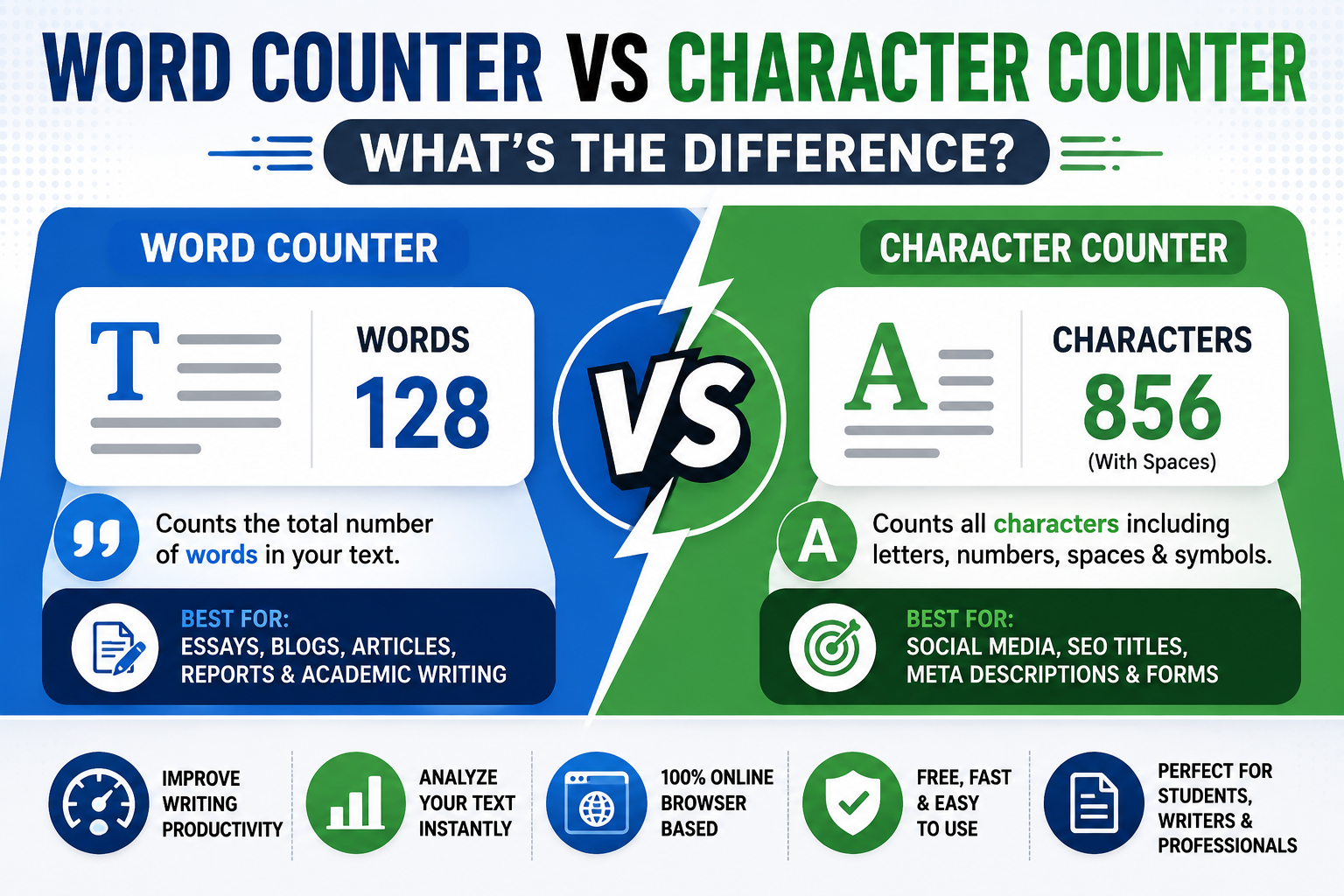
If you work with articles, essays, social media posts, website content, or SEO, you have probably used a word counter or character counter.
Although these tools look similar, they measure different things.
A word counter tells you how many words are in a piece of text, while a character counter measures the number of individual characters.
Understanding the difference helps you choose the right tool for your writing task.
Whether you need an online word counter, a character count for social media, or a quick text counter for content optimization, knowing what each tool measures can save time and prevent mistakes.
What Is a Word Counter?
A word counter calculates the number of words contained in a piece of text.
For example, consider this sentence:
"Online tools make everyday tasks easier."
This sentence contains six words.
A word counter online can calculate that total instantly without requiring you to count each word manually.
Word counting is especially useful for:
- Essays
- Blog posts
- Articles
- Reports
- Speeches
- Assignments
- Website content
- Applications
- Academic writing
For writers, a word counter provides a quick way to make sure content meets a specific length requirement.
What Is a Character Counter?
A character counter measures individual characters in your text.
Characters can include:
- Letters
- Numbers
- Spaces
- Punctuation marks
- Symbols
For example, the sentence:
"Hello world!"
contains characters as well as words.
The exact character total depends on whether the counting tool includes spaces and punctuation.
This is why professional character-counting tools often provide separate totals for:
- Characters with spaces
- Characters without spaces
Word Count vs Character Count
The easiest way to understand the difference is this:
Word count = number of words
Character count = number of characters
For example:
"Free online tools"
contains three words.
However, the character count is higher because every letter and space is counted individually.
This distinction becomes important when a platform specifies a character limit instead of a word limit.
When Should You Use a Word Counter?
Use a word counter when the length of your content is measured by the number of words.
Common examples include:
Essays
Students frequently have requirements such as:
- 500 words
- 1,000 words
- 1,500 words
- 2,000 words
An essay word count tool makes it easy to check whether your assignment meets the required length.
Blog Posts
Bloggers can use a word counter to monitor article length and maintain consistent content standards.
Speeches
A word count can help estimate how long a speech will take to deliver.
Reports
Business reports and academic documents may also have specific word limits.
When Should You Use a Character Counter?
A character counter is more useful when a platform limits the number of characters rather than words.
This is common on social media platforms, advertising systems, forms, and metadata fields.
For example, you might need to keep:
- A social media post under a specific limit
- An SEO title within a recommended length
- A meta description within a suitable range
- An advertisement within a character limit
- A short profile description within a maximum length
In these situations, character count matters more than word count.
Why Character Count Matters for Social Media Writing
Social media writing often requires precise control over content length.
A post may look short visually but still contain hundreds of characters.
Using a character counter lets creators check their content before publishing.
This is especially useful for:
- Social media captions
- Short posts
- Advertisements
- Profile descriptions
- Promotional messages
- Hashtags
For social media writers, a character counter can be just as important as a word counter.
Word Count for SEO Writing
A word counter is also useful for SEO writing.
Search engines do not require every article to reach a specific word count. However, tracking word count can help writers create content that covers a topic comprehensively.
During seo writing, a word counter can help you:
- Monitor article length
- Compare content sections
- Maintain consistent formatting
- Identify overly short sections
- Plan long-form content
The important thing is not to add unnecessary words simply to reach an arbitrary number.
Content should answer the searcher's question clearly and completely.
Character Count for SEO
Character limits are particularly relevant to certain SEO elements.
For example, writers often monitor the length of:
- SEO titles
- Meta descriptions
- URLs
- Image alt text
- Social sharing text
A character count helps prevent important text from becoming unnecessarily long.
However, remember that search-result display is influenced by pixel width and other factors, so character count is a useful guideline rather than an absolute guarantee of how content will appear.
What Is a Text Counter?
A text counter is a general term for a tool that analyzes written content.
Depending on the tool, it may provide:
- Word count
- Character count
- Characters without spaces
- Sentence count
- Paragraph count
- Reading time
This makes a text counter useful for writers who need more than a simple word total.
Online Word Counter vs Manual Counting
Manually counting words is slow and unnecessary.
An online word counter can analyze hundreds or thousands of words instantly.
Instead of estimating your content length, you can paste your text into a tool and immediately see the result.
This is useful when working with:
- Blog posts
- Essays
- Website pages
- Product descriptions
- Reports
- Scripts
- Social media content
For frequent writing tasks, automated counting is much more efficient than manual counting.
How Word Counters Improve Writing Productivity
A good counting tool can improve writing productivity by removing repetitive tasks.
Instead of stopping your writing process to manually count words, you can focus on creating and editing your content.
A simple workflow is:
- Write your content.
- Paste it into a word counter.
- Check the word count.
- Check the character count when necessary.
- Edit the content.
- Check the final version again.
This keeps the writing process simple and efficient.
Word Counter vs Character Counter: Quick Comparison
| Feature | Word Counter | Character Counter | |---|---|---| | Counts words | Yes | No | | Counts characters | Usually | Yes | | Useful for essays | Excellent | Limited | | Useful for blog posts | Excellent | Useful | | Useful for social media limits | Useful | Excellent | | Useful for SEO titles | Useful | Excellent | | Useful for meta descriptions | Useful | Excellent | | Useful for speech planning | Excellent | Limited |
The correct choice depends entirely on the requirement of your task.
Free Text Tools for Writers
Writers often need more than a single counting function.
A useful collection of free text tools may include:
- Word counters
- Character counters
- Text case converters
- Text formatters
- Reading-time calculators
- Text analysis tools
Using several writing tools together can make content creation significantly faster.
Online Text Utilities for Everyday Tasks
Modern online text utilities make common writing tasks available directly in a browser.
You don't need to install specialized software just to count words or characters.
Browser-based tools are useful for:
- Students
- Bloggers
- Copywriters
- Developers
- SEO professionals
- Social media managers
- Business owners
They are particularly convenient when you need a quick result rather than a complete writing application.
How a Word Count Checker Helps Students
Students frequently work with strict assignment requirements.
A word count checker can help verify whether an essay meets its required length before submission.
For example, if an assignment requires 1,000 words, checking the final draft ensures you haven't accidentally submitted only 850 words or unnecessarily written 1,500.
This can also help students distribute content more effectively between:
- Introduction
- Main arguments
- Supporting evidence
- Conclusion
Content Optimization and Text Analysis
Counting words and characters is only one part of text analysis.
Writers can also analyze:
- Sentence length
- Paragraph structure
- Keyword usage
- Reading time
- Content density
These measurements can contribute to better content optimization.
However, numbers should support good writing rather than replace it.
A shorter article that completely answers the reader's question is often more useful than a longer article filled with unnecessary text.
Which Tool Should You Use?
Choose a word counter when you need to know how many words your content contains.
Choose a character counter when you need to stay within a character limit.
Use both when working on content that has requirements for both word and character length.
For example, a blog post may have a target word count while its SEO title and meta description have character-length considerations.
Final Thoughts
A word counter and a character counter solve different problems.
A word counter is best for essays, articles, speeches, reports, and other content where word count matters.
A character counter is better for social media writing, SEO elements, advertisements, forms, and other situations where character limits are important.
If you're looking for a reliable online word counter, character count tool, or collection of browser based utilities, TrendPro provides practical text tools and other free online utilities designed for writers, students, creators, developers, and professionals.
Using the right content writing tools can make writing faster, improve your workflow, and help you meet content requirements without unnecessary manual work.